 THE MAGAZINE




Basile Guibert walks quickly through the vineyards. He knows every turn, every clearing, every grape variety, and speaks of this land with the peculiar precision of someone who has not simply come to know a place, but has grown up with it.
In 1971, Aimé and Véronique Guibert could have looked at this Languedoc valley and wondered how many hectares of vines they could plant there.
Instead, they asked a different question: what could this land give if they were willing to listen to it?
More than fifty years later, that difference in perspective probably says more about Daumas Gassac than all the legends surrounding its wines.
More than fifty years later, that difference in perspective probably says more about Daumas Gassac than all the legends surrounding its wines.
When we think of Mas de Daumas Gassac, we think of the wines, of course. Their depth, their freshness, their almost insolent ability to endure across the decades.
But above all, what stays with you after visiting the estate is a family. A valley. A way of looking at the land. And the powerful sense that nothing here has ever been done by chance.
And yet, the story almost began that way.
In the early 1970s, Aimé and Véronique Guibert discovered a wild valley near Aniane. They did not come from the world of wine, and perhaps that absence of established codes was their first stroke of luck: they were free to invent their own.
Aimé, driven by Véronique’s uncompromising vision, very quickly began making choices that went against the prevailing current.
At a time when agriculture was becoming increasingly standardized and clonal selection was taking hold, he sought out old, non-clonal vines. He collected cuttings from great vineyards, gathered grape varieties and protected rare cultivars. What he sought was not so much yield as character.
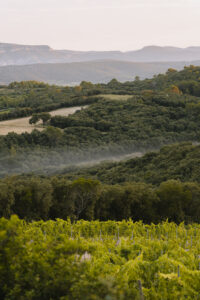
You have to walk through Daumas Gassac to understand just how radical this philosophy is. Here, the vineyard was never imposed upon the landscape. It slipped quietly into it.
The estate’s 44 hectares of vines are scattered across more than 70 clearings, surrounded by 1,000 hectares of Mediterranean forest. To move from one vineyard to another, you pass through woodland. The plots appear almost unexpectedly, emerging from the vegetation.
They could have cleared the land. Rationalized it. Consolidated the plots. Produced more.
They chose not to.
The vines live among grasses, rivers, forests, birds and insects. The grape varieties are kept separate, planted where the soil, exposure and microclimate make sense for each of them. Every plot is observed, tended and harvested according to its own rhythm.
What we now call biodiversity, the preservation of living ecosystems or agroecology was already here more than fifty years ago.
Not as an argument, but as a conviction.
Sharing a meal around the family table, presided over by its matriarch, is a dizzying immersion into the quick, brilliant mind of one of wine’s most remarkable personalities. That encounter allowed us to understand differently everything we had seen in the vineyards.
Véronique Guibert is an ethnologist, a specialist in cultures, myths and traditions. But her academic background does not explain the woman. If anything, it is the other way around.
Perhaps one becomes an ethnologist because one already possesses that curiosity about others, that ability to observe, to listen, to perceive the connections between living things.
What is striking about her is the strength of her convictions and the power of her instinct.
An immediate sensitivity to people and to the land. An ability to sense balances, to understand what a place, a person or a culture might become without ever trying to force it into becoming something else.
And suddenly, the estate takes on another dimension.
Daumas Gassac was not born simply from the ambition to make a great wine. It was born from a particular way of seeing the world.
Aimé passed away in 2016. What remained was the question that every great family story eventually has to face: how do you pass on something so deeply personal without turning it into a monument?
Today, the answer lies in five names: Samuel, Gaël, Amélien, Roman and Basile.
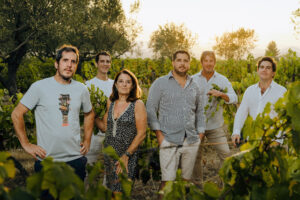
Five brothers and, above all, five distinct personalities.
That is probably what makes the story even more compelling. They have never tried to become five versions of their parents. Each has found his own place, with his own sensibility, responsibilities and perspective. They debate, take the time to make decisions together and continue to share the stewardship of this valley.
Basile accompanied us through the vineyards.
We could talk about his knowledge, the precision with which he explains the soils, the grape varieties, ripeness or vinification. But that is not what is remarkable.
For him, the vine seems to have become a mother tongue. Winegrowing is in his blood.
He knows what has been passed down to him, but above all he has retained that desire to keep searching, experimenting and understanding. And that is where Atelier Guibert becomes so fascinating.
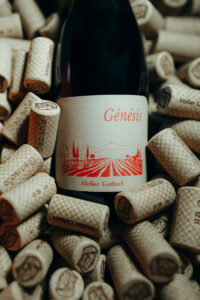
With this project, the family has opened up another space. Individual plots find new forms of expression. There is experimentation. Small-batch vinifications. More intuitive blending. A willingness to try, even at the risk of getting things wrong, because that too is part of moving forward.
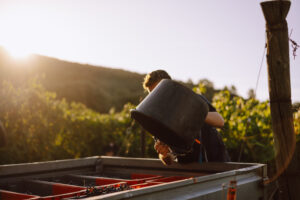
The heart of Mas de Daumas Gassac, created by Aimé and Véronique and carried forward by their children, is not about reproducing a particular method of winemaking. It is about preserving the very thing that made these great wines possible in the first place: freedom.
Mas de Daumas Gassac is a lesson in time.
The time it takes to observe a piece of land before deciding what to plant there.
The time embodied by a forest that one chooses to preserve rather than turn into additional hectares of vineyard.
The time carried by ancient grape varieties, protected while the agricultural world moves towards uniformity.
The time held within a wine that, forty years later, can still tell the story of its vintage.
The time of a mother passing on a vision.
The time of five brothers inheriting an immense legacy and nevertheless choosing to write its next chapter in their own way.
At a time when we are constantly trying to move faster, to optimize, standardize and replicate, Daumas Gassac embodies an almost subversive idea: singularity takes time.
This valley leaves us with far more than the memory of great wines. It offers a sense of rootedness. A profoundly human family. A fidelity to the land that has nothing to do with rhetoric or posture.
And something that has ultimately become quite rare: the feeling of having encountered a place where, for more than fifty years, convictions have been translated into actions.
Our great privilege is that we can taste them.
Betty Marais